Dog Yeast Infections (Candida)
(FTC Disclosure: If you make a purchase via a link on this page, I may receive a small commission, at no added cost to you.)
Overview
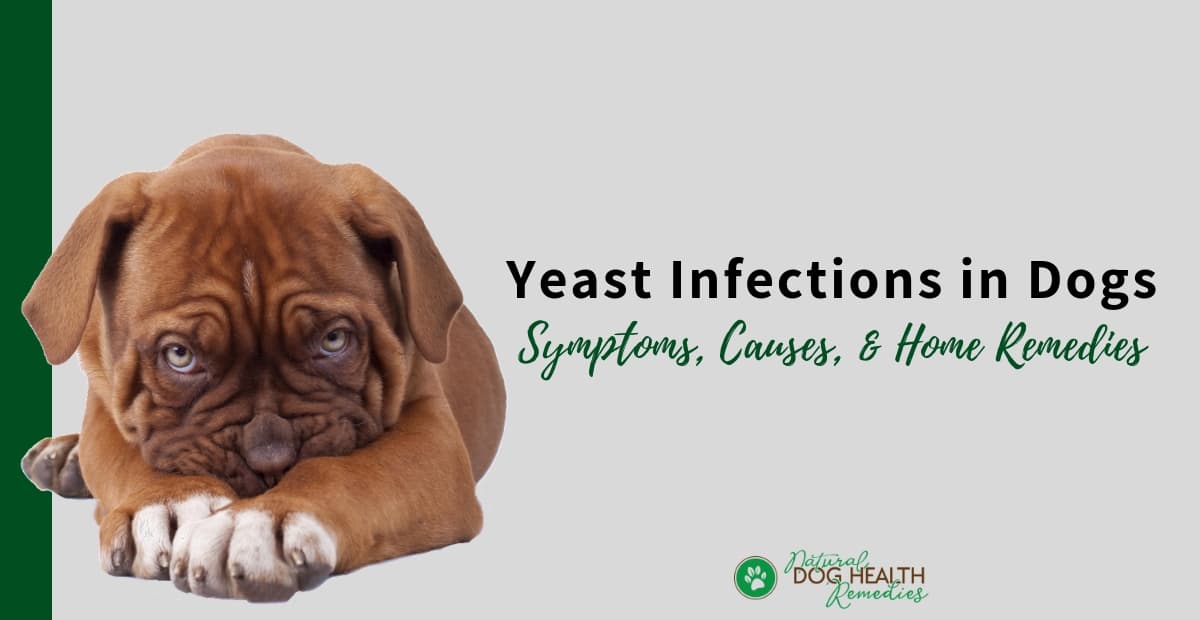
Does your dog scratch and bite her skin incessantly? Is she prone to various skin irritations and problems? Does her skin give out an unpleasant odor? Is antibiotic treatment ineffective in curing the skin problems? Does she have recurring ear infections?
If you answer "yes" to these questions, there is a high chance that your dog is suffering from "dog candida" or dog yeast infections. Read on...
This article looks at:
- What is dog Candida?
- What are the symptoms of dog yeast infections?
- What causes yeast infections in dogs?
- Conventional treatment for dog yeast infections
- Home remedies for dog yeast infections
What is Dog Candida?
Dog candidiasis, aka dog candida or dog yeast infections, is caused by a single-celled organism called Candida albicans which is classified as both a yeast and a fungus.
In a healthy dog with a normally-functioning immune system, there is a balanced level of normal flora in the body. That is, there is a good balance of the "friendly bacteria" and a slight layer of naturally-occuring yeast.
The problem is, when a dog's immune system is out of sync, yeast overgrowth occurs. This can be due to either an under-active immune system, or an over-active immune system.
All pathogens, including Candida, are opportunistic. They tend to take advantage of a dog with a weak, under-active immune system because the system is unable to control and kill off the pathogen.
But why is a dog with an over-active immune system also prone to yeast overgrowth? The answer lies in the treatment of the over-active immune system. Dogs are often given steroids to suppress their over-active immune system. In the long run, this will weaken the immune system to a point where it no longer can keep the opportunistic yeast in check.
Once there is an over-abundance of candida in the dog's body, it will create a vicious cycle. Candida cells manufacture toxic chemicals that kill beneficial bacteria and harm the body.
In addition, waste products produced by candida are toxic chemicals that can slow the brain, causing fatigue and disrupting the immune system.
The end result? A systemic (whole body) yeast infection in the dog, which can cause numerous health problems, including inflammation, chronic infections, and allergies (food allergy, atopic dermatitis).
Symptoms of Dog Yeast Infections
One distinct sign of dogs having a yeast infection is they give out a "musty, moldy-bread" smell.
Another sign is intense itching, causing the dog to constantly scratch, chew, lick, and bite the skin. The dog may also scoot on the floor.
Other signs of dog yeast infections look very much like skin irritations and allergies, with symptoms such as:
- recurring hot spots
- hives
- eczema
- hair loss
- redness or skin rashes, especially on the feet, face, tummy, underarm, or genital areas
- dry and flaky skin, sometimes the skin may turn black or discolored
- itching eyes
- red, irritated eyes
- excessive tearing
- coughing
- bouts of asthma attacks
- frequent sneezing
- abnormal nasal discharge
Systemic yeast infections in dogs may also manifest themselves as:
- ear infections
- urinary tract infections
- bladder infections
- food allergies
- GI problems, such as bloating and gas, diarrhea, vomiting, constipation, etc.
- bad breath
- anal sac problems
- joint pain
- malnutrition due to inability to absorb sufficient nutrients
- fatigue and lethargy
With so many symptoms mimicking so many different dog diseases, you can imagine that sometimes even veterinarians may misdiagnose a case of dog yeast infection as something else!
If your dog unfortunately suffers from recurring infections (be it skin, ear, or others) or has allergies (skin or food) that do not seem to go away, candida may be the culprit.
Download this checklist to help diagnose your dog's yeast infection.
Possible Causes of Dog Yeast Infections
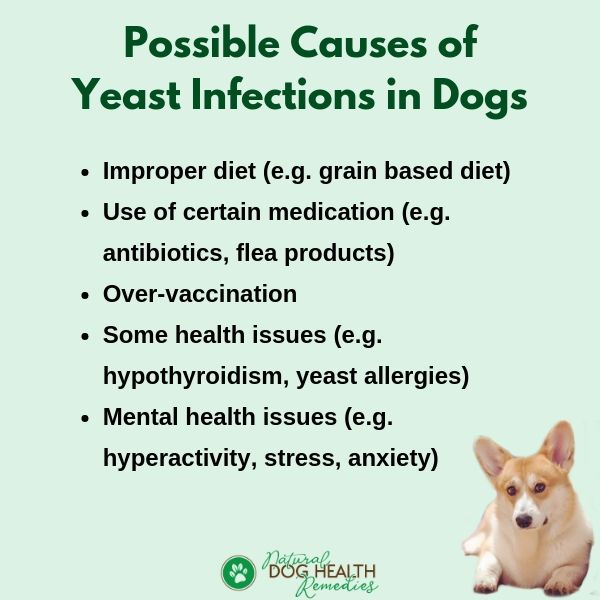
There are many possibilities that can result in yeast overgrowth. The most common causes are listed below:
Improper Diet
- A poor quality diet with insufficient supplements such as probiotics (friendly bacteria) to metabolize sugars (food source for yeast) will result in an overgrowth of candida.
- Insufficient dietary enzymes to clean out the toxins from the body will also result in dog yeast infections.
- A grain-based diet (first ingredient is grains) will increase sugars in the digestive tract - food supply for candida.
Use of Certain Medication
- Use of antibiotics - these drugs can kill off beneficial bacteria in the dog's body.
- Use of flea chemicals - these chemicals can result in a compromised immune system making it easy for candida to thrive.
- Over-vaccinations - over-vaccinations can result in a compromised immune system making it easy for candida to thrive.
Physical Health Problems
- Thyroid problems (hypothyroidism) - many holistic vets (and doctors for people too) believe that there is a direct connection between thyroid problems and yeast infections.
- Other illnesses that compromise the immune system can also make it easy for the candida population to grow.
- Yeast allergy - Some dogs can also develop an allergic reaction to the naturally-occuring yeast in their bodies.
In other words, the immune systems of these dogs attack their own natural flora. When this happens, usually the allergic reaction occurs from head to toe - the dog will be red and itchy from the tip of his nose to the tip of his tail!
Mental Health Problems
- Hyperactivity.
- Stress and anxiety caused by environmental and seasonal changes, as well as emotional and physical changes in the dog.
Diagnosis and Conventional Treatment
Your vet can determine whether your dog has yeast by either cytology (looking at a skin swap under the microscope) or by culture.
Conventional treatment for dog candida usually uses antifungal medications to clear up the infections and related symptoms.
Unfortunately, many such antifungal drugs have potentially serious side effects. Worse still, these drugs only deal with the symptoms without actually addressing the root cause. Before long, there will be another flare-up, very often with worsening sets of symptoms.
Home Remedies for Dog Yeast Infections
 If your dog has a mild yeast infection, you may want to first try using natural home remedies to help him.
Topical control of yeast overgrowth involves removing layers of dead yeast from the body, disinfecting the "yeasty" parts of the dog's body, and controlling yeast growth on the body. This can be done as follows:
Disinfecting the "Yeasty" Parts
Yeast thrives in moist and dark areas such as crevices (ideal places - the "armpits", groin area, under the tail, inside the ears), so be vigilant and disinfect these affected areas.
Cleaning Yeasty Ears
If your dog has yeasty ears, you need to clean the debris in his ears regularly (3-4 times a week or even every day, depending on the amount of "gunk" produced in the ears).
Make a simple ear wash by mixing equal parts of apple cider vinegar and distilled water, and use the mixture to clean out your dog's ears.
I also like using undiluted Tea Tree hydrosol. It's not recommended to use Tea Tree oil inside the ears, but the hydrosol is much milder and can be used for ear cleaning.
Handy Ear Wipes
These wipes contain Lemon, Calendula (Marigold), Aloe Vera, and Green Tea are pre-moistened with an all-natural botanical blend for safe, yet effective cleaning.
Disinfecting Other Yeasty Parts
For other yeasty body parts, make a solution by mixing a gallon of water with one cup of hydrogen peroxide, and one cup of apple cider vinegar.
Use this solution as a wipe to disinfect the yeasty parts. You can also use this solution as a foot soak if your dog has yeasty paws. After wiping and soaking, just pat dry the areas.
Bathing the Dog
It is important to keep washing off the layers of dead yeast from the dog. If you use a natural shampoo, washing the dog frequently (e.g. 2-3 times a week) will not dry out the skin.
However, DO NOT use a shampoo that contains oatmeal (oatmeal is a grain so it is a food source for yeast). Use a natural anti-fungal shampoo such as this one that contains green tea extract (which is anti-fungal): Earthbath All Natural Green Tea Shampoo
Rinsing the Dog
After bathing the dog, use a natural rinse to further prevent yeast growth.
Make a rinse by mixing one gallon of water with one cup of apple cider vinegar and 10 drops of peppermint essential oil and 10 drops of Sweet Marjoram essential oil.
Pour the rinse from the neck down (avoid the head and eye areas). Rub the rinse into the hair and skin, particularly areas such as the armpits, feet, groin, and around the tail. Leave the rinse on and towel dry the dog.
Use this rinse 1-2 times a week.
If you don't have essential oils or hydrosols, try using grapefruit seed extract (GSE). It is also an effective agent to help treat yeasty paws and fungal infections in dogs. Check out more information from this page.
Controlling Yeast Growth on the Skin
After disinfecting and cleaning your dog, apply 100% pure organic coconut oil to the affected skin areas. If your dog has yeasty paws, be sure to rub the oil in between the toes.
Coconut oil is anti-inflammatory, anti-viral, anti-fungal and anti-bacterial, and is a cheap and efficient way to help control yeast growth, as well as to heal skin irritations and inflammation caused by yeast infections.

Natural Remedies for Internal Use
In addition to using the above home remedies to topically control dog yeast infections, remedies should be used to control yeast internally. This is especially important if your dog has systemic yeast infections. Be sure to visit this page for more information.
Eldredge, et al. Dog Owner's Home Veterinary Handbook 4th edition (Wiley Publishing, 2007).
C.J. Puotinen, Natural Remedies for Dogs and Cats (Keats Publishing, 1999).
M. Goldstein, The Nature of Animal Healing (Ballantine Books, 2000).
R.H. Pitcairn, The Complete Guide to Natural Health for Dogs and Cats (Rodale, 2005).