Dog Bloating Can Be Fatal
(FTC Disclosure: If you make a purchase via a link on this page, I may receive a small commission, at no added cost to you.)
What is Bloating in Dogs?
Bloating is a serious and acute medical condition characterized by a rapid accumulation of gas in the stomach.
This condition is unfortunately a top killer of dogs, and deep-chested large breeds (e.g. Great Danes, German Shepherds, Dobermans) are especially vulnerable. However, bloating can happen to smaller breeds as well.
Gastric Dilatation and Volvulus
"Gastric dilatation" is the condition of bloating (gas accumulation) in the stomach, whereas "volvulus" refers to the condition of a "twisted stomach". Bloating can occur with or without "volvulus" (stomach twisting).
The basic mechanism of stomach bloating is, the stomach fills up with air and puts pressure on the other organs and diaphragm, causing breathing difficulty for the dog and distension (expansion) of the stomach. When the stomach is distended, it can easily rotate 90 to 360° on itself (like a balloon).
The twisting traps air, food and water in the stomach. Moreover, it can completely block entry of blood supply into the organ.
As the blood supply is cut off, the stomach tissue begins to die, and the stomach will eventually rupture, in which case peritonitis (abdominal infection) will occur which is usually fatal.
Both conditions (gastric dilatation and volvulus) can be life-threatening, although it often takes longer for a gastric dilatation without volvulus to become critical.
Mild bloats without volvulus may last for minutes to hours, and sometimes even days without it becoming life-threatening. However, with volvulus, it is a different story. The dog can go into shock within minutes.
Dog bloat is one of those conditions that only veterinarians, with the help of x-rays, can determine the seriousness of a particular case, and whether surgery is necessary to resolve the problem.
It is important, therefore, that we seek veterinary help immediately if our dogs show signs of bloat.
Signs of Bloating in Dogs
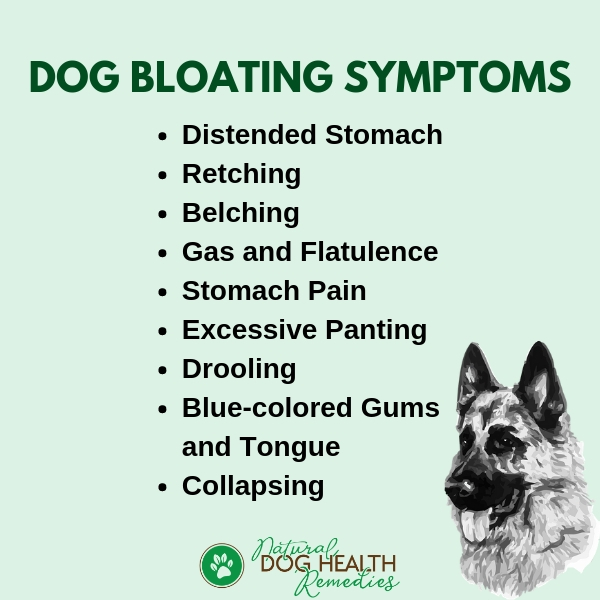
A dog that is suffering from bloat may show some of the following signs and symptoms about 2 to 6 hours after eating.
The first typical sign of bloat in dogs is you will notice that your dog's upper abdominal area has become enlarged and distended (feels like a tight drum).
Another typical symptom is retching - your dog tries to vomit but nothing comes up.
Other signs include:
- Abdominal pain (e.g. whining, dog may have his back hunched up, restlessness)
- Flatulence and excess gas
- Belching
- Shock-like symptoms (e.g. excessive panting, blue-colored gums and tongue, collapsing)
Warning Signs!
If you notice the following symptoms in your dog, seek immediate medical treatment:
- Severely distended abdomen (usually appearing rapidly)
- Excessive drooling, due most likely to pain
- Panting
- Unsuccessful attempts to vomit (the dog may desperately try to eat grass to induce vomiting)
- Retching
- Restlessness and discomfort from abdominal pain (often lying down and getting up repeatedly)
- Sudden weakness or collapse or lethargy
- Gums may turn bluish or mud-colored (critical stage)
What Causes Bloating in Dogs?
A dog develops bloat due usually to a combination of reasons, some of which are medically unknown, but veterinarians have established links between dog bloat with certain contributing factors:
Breeds and Build
Bloat seems to be closely related to the breed and build of a dog.
Large breeds with deep and narrow chests are more likely to have this condition.
The Great Dane, Saint Bernard, Standard Poodle, Akita, Basset Hound, Bloodhood, Boxer, Borzoi, Irish Setter, German Shepherd, Doberman Pinschers, Weimaraners, Old English Sheepdog and other large, deep-chested mixed breeds are among those that are prone to develop bloat.
Researchers have also found that pure-bred dogs are 2.5 times more likely to develop dog bloat than mixed breed dogs.
Existing Medical Condition
It has been found that dogs suffering from exocrine pancreatic insufficiency (EPI) are at a higher risk of developing bloat. (EPI is a condition in which the part of the pancreas that produces digestive enzymes does not function properly.)
Age and Gender
Bloat occurs most commonly in dogs between 2 to 10 years old. Male dogs are twice as likely to develop bloating as females.
Eating Habits
Dogs that are fed once a day are found to be twice as likely to develop bloat as those fed twice a day. If a dog is fed once a day, he is likely to be more hungry at mealtime and tends to eat rapidly - a likely factor causing bloat in dogs.
Dog's Disposition/Temperament
Dogs who tend to have high anxiety, fear, or show aggression easily also tend to develop bloat.
Food
Dry food or concentrated foods that absorb water after being eaten and expand in the dog's stomach can also cause bloat.
A study conducted by Purdue University reveals that dry food that contains a fat source in the first four ingredients are more likely (170%) to cause bloat in dogs than foods without a fat source in the first four ingredients.
Although no studies have been done on the effect of home-prepared diet on dogs regarding bloating, anecdotally many holistic veterinarians have reported that home-made diets can greatly reduce the risk of bloat.
Some types of food (e.g. beans, cheese) can also cause bloating in dogs.
Exercise Time
A dog that exercises soon after a meal may also be at increased risk of developing bloat.
Treatment for Dog Bloat
For bloating (without twisting), the vet will decompress the stomach by inserting a tube in the dog's stomach to relieve the gas.
If there is also volvulus, surgery is needed to straighten out the stomach. The vet will also suture the stomach in a way to prevent it from twisting again.
How to Deal With Bloating in Dogs
When you see any sudden distension of your dog's stomach, especially shortly after eating, take him to the veterinarian immediately for treatment.
If, however, in an emergency situation and you cannot get to a vet in time, homeopathic remedies can be used to relieve bloating or improve the condition, especially if you can catch the bloating at an early stage and administer the remedy immediately.
If your dog is susceptible to bloat, it is a good idea to consult a holistic vet regarding using homeopathic remedies as an emergency home treatment. It is of course necessary to stock your dog first aid kit with the necessary remedies.
Homeopathic Remedies
For Emergency Use Only - After administering one of the following remedies, it is still important to take the bloating dog to a veterinary hospital for treatment.
Belladonna
 This remedy is appropriate if there is a sudden onset of bloating, and if the symptoms are intense and serious. Dogs needing this remedy are agitated, restless, and the pupils are dilated. The mouth and the head may be hot.
Nux Vomica
Dogs that require this remedy usually develop bloating some time after eating - maybe even several hours later. They will try desperately to vomit but without success, resulting in retching constantly. The dogs will also become irritable and chilly. Nux is the best emergency treatment for volvulus.
Carbo vegetabilis
This remedy is useful for acute bloat. Dogs that need this remedy are seriously distended and look very sick and weak, with cold legs and ears, and bluish color to the tongue and gums. They may even be in a state of shock and may collapse.
Argentum nitricum
This remedy is good for dogs that have a tendency to chronic bloating. Their mouth may be full of mucus and they may vomit mucus. Their stomach and abdomen are generally painful.
Preventing Bloat in Dogs
- Food: If your dog is susceptible to bloating, avoid feeding him dry food that absorbs water after being eaten, or at least pre-soak the food in water for 30 minutes before feeding your dog. It is preferable, however, to feed your dog fresh meat-based diets instead of dry food.
- Supplements: To help your dog digest food properly, give him supplements of
digestive enzymes and probiotics.
Good Natural Products
This supplement provides a combination of plant enzymes to support complete digestion of all types of nutrients, such as proteins, carbohydrates and fats.
This formula is a multi-strain combination of bio-available microorganisms in a prebiotic base of fructooligosaccharide (FOS).
- Feeding Habits: Feed your dog smaller portions, two or three times daily, instead of just one big meal a day.
If your dog gulps down his food, consider getting a bowl that slows down eating. Also, remove your dog's food after a while if it is not finished. Even short periods of fasting throughout the day are very important for effective digestion and detoxification.
- Stress-free Feeding Time: Some dogs gulp down their food because they fear that other pets in the family may "steal" their food. If you have several pets in the house, try to feed them at different times or separately in different rooms if possible.
Emotional stress can also have an effect on digestion.
- Water: Limit your dog's water input immediately after eating.
- Avoid "Junk Food": Keep the garbage lid on. Do not let your dog eat everything and anything - eating something not agreeable with your dog's stomach can cause gas to accumulate.
- Exercise: Regular exercise is helpful, but avoid vigorous exercise or excitement one hour before and two hours after meals.
- Be Observant: If your dog is one of those breeds that are prone to bloat, be observant and be aware of the early signs of bloat.
- Be Prepared: Stock your dog first aid kit with some of the above homeopathic remedies for emergency use, and consult with a holistic vet about the proper use and dosage of each remedy.
Eldredge, et al. Dog Owner's Home Veterinary Handbook 4th edition (Wiley Publishing, 2007).
C.J. Puotinen, Natural Remedies for Dogs and Cats (Keats Publishing, 1999).
R.H. Pitcairn, The Complete Guide to Natural Health for Dogs and Cats (Rodale, 2005).
D. Hamilton, Homeopathic Care for Cats and Dogs (North Atlantic Books, 1999).