Enzymes for Dogs
(FTC Disclosure: If you make a purchase via a link on this page, I may receive a small commission, at no added cost to you.)

Overview
Digestive enzymes are essential for a dog's physical wellbeing. More and more veterinarians are now suggesting that we should give digestive enzyme supplements to our dogs to maintain and support their health.
This page is put together to help you better understand what enzymes are, and why they are important for dogs' health.
In particular, the following questions will be answered:
- What are digestive enzymes?
- How do enzymes help digestion?
- What will happen when food enzymes are depleted?
- What are other benefits of enzymes for dogs?
- Do all dogs need digestive enzyme supplements?
- How can you add digestive enzymes to your dog's diet?
- Are enzymes safe for dogs?
What are Enzymes?
Enzymes are "organic catalysts". They either initiate or speed up chemical reactions in the body, from digestion to tissue repair, and from hormone function to energy production.
Enzymes are present in every cell in both plants and animals, and can exist both in active and inactive forms in cells.
They are, however, extremely sensitive and can be permanently inactivated or destroyed by high heat, as well as elements such as chemicals in food preservatives, artificial colorings and flavorings, and so on.
Enzymes are needed to digest the food eaten. For this purpose, two types of enzymes can be used to perform this task - the enzymes that come from the food we eat (food enzymes), and the enzymes that are produced internally from the digestive organs (digestive enzymes).
However, as mentioned above, enzymes can be inactivated or destroyed when there is a change in temperature.
Specifically, when food is cooked or processed at temperatures 118°F or above, the enzymes in the food are destroyed. (It means if you feed your dog foods cooked under high heat, such as kibbles or canned food, your dog cannot get enough digestive enzymes from the food).
Without these food enzymes, the body has to work harder and create more digestive enzymes to fully digest the food.
How do Enzymes Help Digestion?
Food in its natural, uncooked state, contains live enzymes. It follows that if our dog consumes raw food, the enzymes in the food can greatly aid in the digestion process.
If your dog eats raw food, the chewing process releases the enzymes contained in the cells of the food. Also, when a dog eats, the pancreas secretes the proper amounts and concentrations of enzymes for digestion as well.
The enzymes that help in food digestion include:
- Protease - responsible for breaking polypeptides (proteins) into amino acids;
- Amylase - responsible for reducing carbohydrates (starches and other polysaccharides) to sucrose, lactose, and maltose;
- Lipase - responsible for digesting fats into fatty acids, glycerol;
- Cellulase - responsible for breaking down fiber.
What will Happen when Food Enzymes are Depleted?
When there is insufficient food enzymes for dogs, the full digestive burden will be placed on the dog's pancreas to produce digestive enzymes.
The result? An over-stressed digestive system which eventually can lead to improper food digestion and nutrient malabsorption.
And the consequences of improper food digestion? The undigested proteins, fats and carbohydrates promote the growth of unwanted bacteria which, over time, upsets the delicate balance of the "gut flora", resulting in:
- bloating
- diarrhea
- gas
- bad breath
- body odor
- lethargy and sluggishness
With improper digestion and nutrient malabsorption, a number of physical problems will arise. Here are some common ones:
- A compromised immune system
- Allergies (food, seasonal, etc.)
- Arthritis (e.g. osteoarthritis, hip dysplasia)
- Skin problems (e.g. hot spots)
- Cancer
- Premature aging
What are Other Benefits of Enzymes to Dogs?
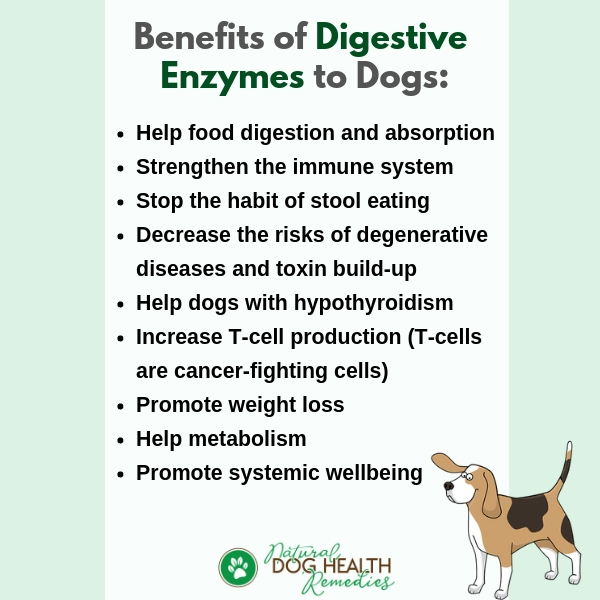
Besides helping in food digestion and nutrient absorption, enzymes for dogs are also beneficial in numerous other ways, such as:
- strengthening the immune system;
- stopping coprophagia (the habit of stool eating);
- decreasing the risks of degenerative diseases such as osteoarthritis, and toxin build-up;
- increasing T-cell production (T-cells are cancer-fighting cells);
- promoting weight loss.
In particular, if your dog is suffering from joint pain caused by arthritis, has an autoimmune disease, has cancer, is recovering from injuries, or has chronic skin problems, it is worth looking into "systemic enzyme therapy", or proteolytic enzyme therapy.
Proteolytic enzymes (aka proteases, which break down proteins) have been used in people and pets to help manage inflammation and pain, improve blood circulation, and more.
Examples of proteolytic enzymes include bromelain (from pineapple), papain (from papaya), and pancreatin, trypsin, and chymotrypsin (from the pancreas). They work best for inflammation when combined with bioflavonoids such as rutin.
Given between meals, proteolytic enzymes, simply put, work to break down proteins in the blood that cause inflammation, and to remove fibrin, which is an insoluble protein that prolongs inflammation.
Proteolytic enzymes also break down cellular debris at injured site, thus helping to shrink growths, remove scar tissues and promote healing.
For proteolytic enzymes to work systemically, they have to be given at least one hour before meals or two hours after.
However, since proteolytic enzymes have blood-thinning effect, they increase the risk of bleeding, especially at higher doses. Dogs with the following issues should not be given proteolytic enzymes:
- Blood clotting disorders
- Stomach ulcers
- Dogs on warfarin or other blood-thinning medications.
As well, supplementation of proteolytic enzymes should be stopped 48 hours prior to surgery but they may be re-started immediately post-surgery to reduce pain and facilitate rapid healing.
Do All Dogs Need Digestive Enzyme Supplements?
Even healthy dogs can benefit from enzyme supplements for optimal digestion and toxin elimination. With better digestion, our dogs will have less gas, firmer stools, and fresher breath. They will also have a healthier, shinier coat with fewer skin problems.
 Enzymes as supplements are particularly beneficial for dogs who:
- are fed cooked or processed food
- are suffering from digestive disorders
- are under stress
- are senior dogs (Older dogs tend to produce lesser amounts of enzymes. Many also suffer from zinc deficiency resulting in low immunity - enzymes seem to be able to increase zinc levels in the body)
- have a weakened immune system due to medications such as antibiotics
- are suffering from systemic yeast infections
- are suffering from thyroid problems such as hypothyroidism (Enzymes enhance the absorption of selenium which is an antioxidant that works in conjunction with vitamin E. Selenium is essential in converting the inactive form of thyroid hormone (T4) to the active form (T3).)
How Can You Add Digestive Enzymes to Your Dog's Diet?
If you want to use digestive enzyme supplements to help your dog with food digestion and absorption, give the enzyme supplements with meals.
Just sprinkle the enzyme powder (or if it's a capsule, open the capsule and sprinkle the powder inside) on your dog's wet food (if you feed your dog kibbles, moisten them first), mix well and let stand for 10-15 minutes to allow the enzymes to help predigest the food.
On the other hand, as mentioned above, if you want to unleash the power of digestive enzymes to help with your dog's metabolism and systemic well-being, you should give the enzymes to your dog one hour before meals or two hours after.
Are Enzymes Safe for Dogs?
Extensive research has been conducted with pets (and people as well!), and it has been found that enzymes for dogs are extremely safe, especially when given with meals. No side-effects have been found from the supplementation of enzymes to dogs. When given in between meals, precautions have to be taken (see above).
Just make sure that the supplement doesn't contain any artificial color, flavor, preservatives, and other potential allergens such as corn, wheat and soy.

Good Products of Enzymes for Dogs
Prozyme is a scientifically proven, all natural supplement of digestive enzymes (lipases, amylases, proteases, and cellulases).
Supplementing your dog with Prozyme (which can be sprinkled on your dog's food) helps replenish the digestive enzymes in canned and dry dog foods which are destroyed while the foods are being processing. Therefore, adding Prozyme to your dog's food ensures better digestion and absorption of nutrients.
This natural product contains not only enzymes but also probiotics and prebiotics to facilitate healthy and effective digestion, and support immune health.
This product contains 4 plant-based enzymes (protease, amylase, lipase, cellulase) to ensure proper digestion and absorption of nutrients throughout the entire digestive system.
C.J. Puotinen, Natural Remedies for Dogs and Cats (Keats Publishing, 1999).
S. Messonnier, The Allergy Solution for Dogs (Three Rivers Press, 2000).
Controlling Inflammation with Proteolytic Enzymes.
Proteolytic Enzymes - Natural Pain Relief for Dogs (Whole Dog Journal, July 1012).