Causes of Dog Scooting on Floor
(FTC Disclosure: If you make a purchase via a link on this page, I may receive a small commission, at no added cost to you.)
Overview
Scooting refers to a dog dragging and rubbing his bum on the floor.
When a dog is scooting, you can see that his hind legs are extended in front of him as he drags himself forward and slides across the floor on his bottom.
But why do dogs scoot on their rear ends?
Puppies and dogs scoot mainly because of two reasons: either they feel pain or they have an itchy bum!
Dogs cannot scratch their rear ends, and it is not so easy for their mouth to reach all the way to the back to chew and lick, so scooting is a way for dogs to "scratch" their itchy, painful bottom. It is also one way for dogs to get rid of dirt or fecal matter that may have stuck there.
What causes a dog to have a painful or itchy bum? Let's find out!
Causes of Dog Scooting
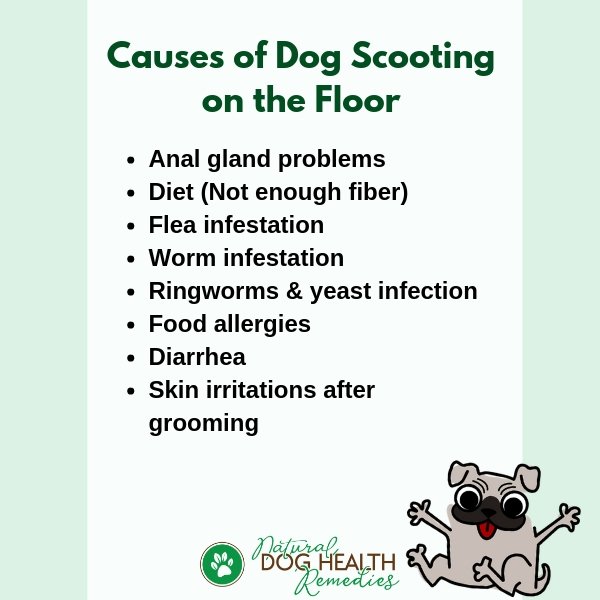
As mentioned above, puppies and dogs scoot because their rear ends are either itchy, painful, or dirty. There are various reasons why their rear ends may feel that way. The most common root causes include:
Anal Gland Problems
Anal gland diseases include impacted anal glands, infected or abscessed anal glands, anal gland tumors. Perhaps the most common cause of scooting is impacted anal glands.
You can easily tell if your dog has impacted anal glands by the distinct foul smell coming from his rear end!
If your dog's anal glands are impacted, you need to express (empty out) them manually.
Read this page for more information about this problem and how to manually express a dog's anal sacs.
A Natural Home Remedy for Dog Scooting
(Click on the affiliate link to find out more) Newton Homeopathics Scoot StopperThis homeopathic remedy helps relieve symptoms such as scooting and scratching caused by itching and anal gland engorgement.
Diet
Closely related to impacted anal glands is a dog's diet. Usually, when a dog gets enough fiber from the diet, his stool is firm and, when pooping, the firm stool presses against the anal sacs, helping them to be emptied out.
But, if the dog's diet is low in fiber, the stool is too soft to put pressure on the anal sacs. Over time, the sacs will become impacted.
If you feed your dog a raw diet with bones, he should be getting enough fiber from the bones. If your dog is on a cooked diet, or eats dry food, you may want to add more fiber to his diet. Pure pumpkin puree is a good healthy choice. Steamed veggies (e.g. broccoli, kale, carrots, etc.) can also be added.
Flea Infestation
 Another common reason that gives your dog an itchy bum is fleas. Fleas are usually found near your dog's rear end and tail area because they are safely out of reach of your dog's mouth!
Flea bites can cause intense itching to dogs, especially those suffering from flea bite allergy. As a result, the dog may scoot and rub his bum on the floor in an attempt to "scratch" his itchy bottom.
If your dog scoots and is often trying to lick or bite his rear end, suspect fleas (or worms - see below). Use a flea comb to check for signs of fleas. Also read our page on Natural Flea Control to see how to get rid of fleas naturally.
Worm Infestation
If your dog has tapeworms, the worm segments can cause itching and irritation as they exit the anus and collect on the skin and surrounding hair. If your dog scoots every so often, be sure to check your dog's stools and his anal area for signs of worms.
Ringworm and Yeast Infection
Fungi such as ringworm and yeast can cause skin infection around the tail and cause intense itching.
Food Allergies
Food allergies cause intense itching (especially at the rear end) and excessive licking.
The saying used to describe food allergy symptoms is: "Food allergies hit the ear and the rear"! The result? Constant head shaking, as well as butt scooting and dragging on the floor!
If you suspect that your dog is allergic to his food, you need to identify the food that is causing the allergic reactions. Read more on food allergies and elimination diets here.
Causes of Occasional Butt Scooting in Dogs
If your dog scoots occasionally, it may be because of the following reasons:
After Pooping
Sometimes, a dog may scoot on the floor after pooping. It may be because some fecal matter has got stuck around the anal area.
In particular, if a dog has diarrhea, his bum may feel irritated, and also fecal matter may be stuck to the hair around the anal area. As a result, the dog may scoot on the floor in an attempt to scratch the butt and to clean it.
Skin Irritation after Grooming
Very often, dogs who are frequently groomed may suffer from clipper burns or skin irritation after grooming. If your dog scoots and licks its rear end obsessively after grooming, check for clipper burns or skin irritation caused by shampoo, sprays, or other grooming products.
If your dog's bum looks red and irritated after a haircut, try putting some pure aloe vera gel
on the area. Aloe vera is extremely cooling, soothing and skin healing.
 on the area. Aloe vera is extremely cooling, soothing and skin healing.
Other Things That May Accompany Scooting
If your dog drags his bum on the floor frequently, watch out for the following:
- Frequent attempts to lick the anal area
- Quickly circling (like chasing his tail) trying to lick the area
- Foul odor from the anal area
- Discharge or swellings in the anal area
When To See a Vet?
If you find your dog scooting for over a couple of days, or if you notice that the dog's anal area has become swollen or inflamed, then it's best to take him to the vet for a checkup.
The vet will most likely examine the anal glands, to see if they are impacted or even infected.
If the anal glands look fine, the vet may try to obtain a fecal sample to check for intestinal worms.
To Recap ...
As you can see, scooting is an unhealthy activity for your dog because it easily drives bacteria into the skin and the anal sac ducts.
Scooting is also unhygienic for your floor or carpet - by scratching his bum on your floor, your dog can leave behind a foul odor, germs, and sometimes fecal matter. You may see unsightly "skid marks" on your white carpet after your dog's scooting activity!
Identifying and treating the underlying root cause is essential if you want to get rid of this problem.
ReferencesC.J. Puotinen, Natural Remedies for Dogs and Cats (Keats Publishing, 1999).
M. Goldstein, The Nature of Animal Healing (Ballantine Books, 2000).
L. Olson, Raw and Natural Nutrition for Dogs: The Definitive Guide to Homemade Meals (North Atlantic Books, 2010).