
Dog Prostate Problems
Overview
The dog prostate gland lies within the pelvis just behind the bladder and directly below the rectum. Its function is to supply the fluid that transports sperm.
Dogs neutered before puberty cannot produce the male hormone testosterone, without which the prostate gland does not develop. If a dog is neutered after maturity, the gland will shrink to less that one-fourth of its previous size and cease functioning within a few months.
For dogs that are neutered, therefore, they seldom have problems with their prostates, although they might still develop prostate cancer.
On the other hand, many intact dogs develop some form of prostate problems when they become older, although problems can arise in much younger dogs (sometimes as young one to two years old) if they are intact but are sexually inactive.
Generally speaking, prostate problems in dogs start appearing when the dogs are around 6.
Common Prostate Problems in Dogs
Here are some common prostate problems that may affect male dogs:
Prostate Enlargement
Enlargement of the prostate, medically known as benign prostatic hyperplasia (BPH), or prostate hypertrophy, is by far the most common prostate problem among intact male dogs.
It is not cancerous but a normal aging process of the gland. As such, this canine prostate problem affects almost all intact dogs over 4-5 years of age.
When the prostate is starting to swell, it presses against the rectum, causing discomfort. If untreated, and when the gland continues to enlarge, it very often causes problem with both urination and defecation.
For mild enlargement of the prostate, herbs and supplements can help.
For more severe cases, neutering the dog can solve the problem.
Inflammation
Another common prostate problem is inflammation (prostatitis), which may be caused by bacterial infections.
Bacteria can get into the prostate via the blood system or from the urinary tract. When inflammation is present, you can find blood in your dog's urine. The blood will come at the end of urination rather than throughout urination.
Other symptoms may include weakness and lethargy, fever, straining to urinate, appetite loss and weight loss.
Prostatitis is usually treated by antibiotics.
Prostate Cancer
Cancer of the prostate is uncommon in dogs. However, when they do occur, they are usually malignant and potentially life threatening.
It is difficult to control or treat due to the delicate location of this gland (around the junction of the bladder and the urethra). Surgical removal of the prostate in dogs may result in urinary incontinence.
Only short-term remission and/or relief is possible through radiation and medical therapy.
Visit this page for more information on prostate cancer in dogs.
Signs of Dog Prostate Problems
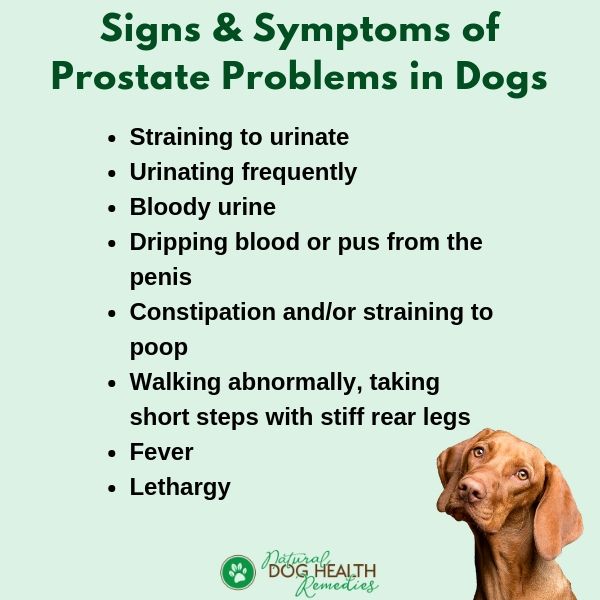
Dogs with prostate problems show some of the following signs:
- Straining to urinate
- Urinating frequently
- Bloody urine
- Dripping blood or pus from the penis
- Constipation and straining to defecate
- Walking abnormally, taking short steps with stiff rear legs
- Fever
- Lethargy
Conventional Treatment of Dog Prostate Problems
As mentioned above, if a dog has a prostate problem that is severe, very often neutering (castration) is recommended.
After the testosterone-producing testicles are removed, the prostate gland will shrink and any prostate issue will be much easier to treat.
To prevent future prostate problems in a male dog, therefore, many veterinarians suggest having the dog neutered by puberty. This will prevent over 90% of all prostate problems in the course of the dog's life.

Natural Remedies for Dog Prostate Problems
Quite a few natural remedies and supplements, such as herbs, homeopathic remedies, minerals and vitamins, can be used to treat some dog prostate problems.
Please visit this page for more information.

Eldredge, et al. Dog Owner's Home Veterinary Handbook 4th edition (Wiley Publishing, 2007).
M. Goldstein, The Nature of Animal Healing (Ballantine Books, 2000).
R.H. Pitcairn, The Complete Guide to Natural Health for Dogs and Cats (Rodale, 2005).