
Dog Pain Relief
Overview
We don't want our dogs to suffer, so when our dogs are in pain, we naturally want to use dog pain medications to relieve their pain.
Dog pain relief comes in many forms - OTC medication, prescription drugs, nutraceuticals, and alternative remedies and treatment such as herbs and acupuncture.
This article looks at:
- Signs and Symptoms of a Dog in Pain
- Possible Causes of Pain in Dogs
- Can I Give My Dog OTC Pain Medications for People?
- NSAIDs as Painkillers for Dogs
- Other Conventional Pain Medications for Dogs

Looking for Natural Dog Pain Relief?
If you are looking for natural remedies such as herbs and nutraceuticals for dog pain relief, please visit this page.
Signs and Symptoms of A Dog In Pain
Unlike us, dogs don't complain and cry about their pain - They usually hide their pain and suffer in silence. That is their natural instinct for survival.
So how can I tell if my dog is in pain? You may ask.
There are telltale signs - both physical and behavioral - that may indicate a dog is in pain. By being observant and alert to these signs, we can get an early diagnosis of possible health problems, or give our dog pain relief sooner to minimize his discomfort and suffering.
Signs and symptoms to look out for are:
Vocalizing
- Whining
- Howling
- Whimpering
- Yelping
- Groaning
Posture
- Hunched (with hindquarters raised and front end down on the ground)
- Limps
- Carries his head or tail off center
- Lays on his side
Facial Expression
- Grimaces, especially when touched
- Vacant stare
- Wide-eyed or looks tired and sleepy
- Dilated pupils
- Flattened ears
- Pants excessively even when resting
Activity Level
- Restless
- Reluctant to move
- Difficulty getting up from a laying position
- Unable to rest comfortably - gets up and lies down repeatedly
- Trembling, circling or lying very still
Behavioral Changes
- Becomes grouchy and aggressive (especially a previously friendly dog)
- Growls, hisses, bites when being touched
- Doesn't want to be held or picked up
- Pins ears back
- Hides (e.g. under the bed)
- Withdraws from social interactions
- Relunctant to play
- Loss of appetite
- Lethargy
- Excessive drooling
- Becomes more "clingy" than usual
- Incessant scratching or licking a particular part of the body
Possible Causes of Dog Pain
As you can imagine, there are zillions of possible reasons that can cause pain to our dogs. Here are some of the most common causes:
Arthritis
Arthritis is one of the most common dog health problems. Arthritis can be caused by genetic conditions such as hip dysplasia, or can be the result of a number of degenerative processes. Of course, it can also be secondary to an earlier injury or surgery.
Read more about arthritis in dogs here.
Back Problems
Back problems can also cause a lot of pain to the dogs. Back problems in dogs can range from something like a pulled muscle to something more serious like a herniated disk.
Click here to learn more about different back problems in dogs.
Injuries
Injuries such as bone fractures, sprains, bruises, etc., as well as insect bites and stings can also cause a lot of pain to our dogs.
Ear Infections
Dog ear infections, especially when spread to the middle or inner ear, can be extremely painful. Usually the dog will shake his head violently and will scratch the affected ear incessantly. He may also rub his head against the wall or furniture.
You can find detailed information on this ear problem here.
Eye Problems
Eye problems, such as ocular infections, ulceration of the cornea, glaucoma, etc., can be another source of pain and discomfort for our dogs. Dogs with eye problems usually will consistently scratch the affected eye with their hind leg.
They may also rub their eye against the bed, carpet, furniture, etc.
Read more about different eye problems that can affect our dogs here.
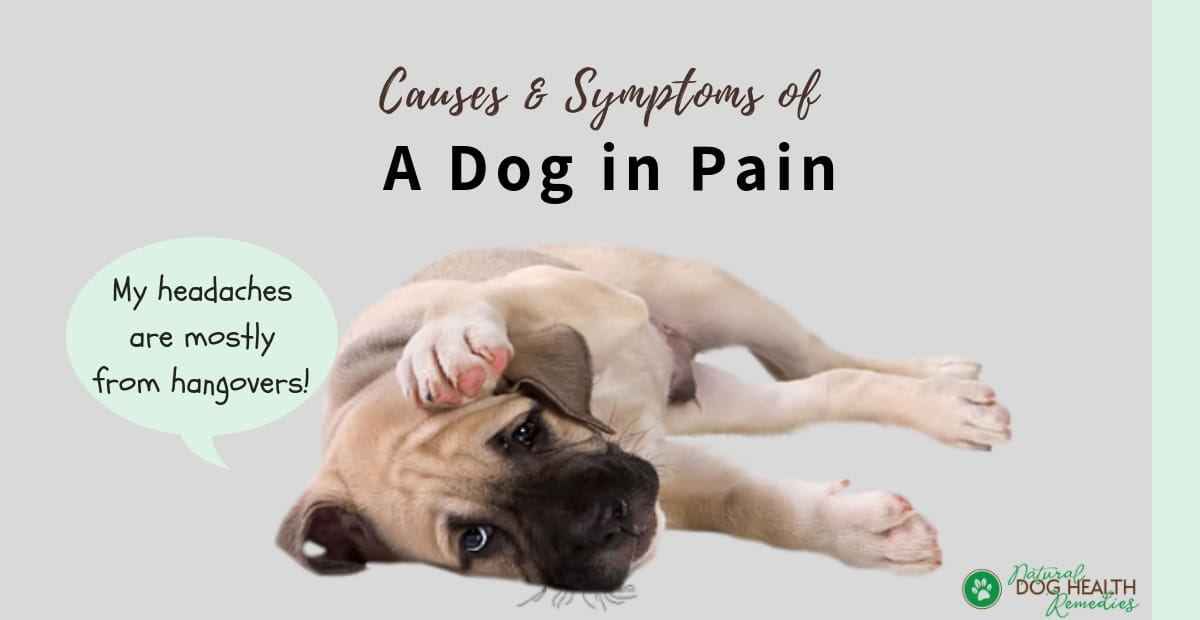
Headaches
Yes - dogs suffer from headaches too! They may develop nervous migrane or the headache may be as a result of a tumor.
Usually a dog suffering from headache has a fixed stare, or he may have his eyes closed. He will shake his head lightly and repeatedly from side to side, he may scratch his head, or rub his head against furniture or on the rug.
Dental and Gum Problems
Tooth decay, abscesses, and gingivitis are all culprits that cause great pain to our dogs. Dogs suffering from dental or gum diseases usually drool, sometimes cough, and have no appetite. It is therefore important to take care of our dog's teeth and gums.
Click here for more information about dog oral problems and dental care.
Problems with the Digestive System
 Indigestion caused by eating something inedible, poisoning, bloating, or obstruction of the intestines can cause abdominal pain to our dogs.
Dogs with abdominal pain will rub their lateral abdomen against walls or furniture. They may also lay down and unwilling to get out of bed. They will try to lick their abdominal area.
Urinary Tract Infections
Another painful dog illness is urinary tract infections. Dogs with UTIs have a curved back because they have back pain. They urinate frequently and sometimes in inappropriate places. They also experience pain while urinating.
Read more about dog UTIs here.
Anal Sac Impaction
Dogs who have anal sac problems are always licking or even biting the anal area. They will scoot on the floor leaving unsightly "skid marks". Because of the pain from the rear end, they tend to sit down extremely carefully, looking backwards all the time.
Read more about anal sac impaction here.
Cancers
Dog pain can of course be also caused by cancers of various types. Cancer is rather common in dogs, especially senior canines. We have a whole section on cancer in dogs, click this link for more information.
Can I Give My Dog OTC Pain Medications for People?
Except for Aspirin (see below), OTC painkillers for people, such as Acetaminophen (e.g. Tylenol®) and Ibuprofen (e.g. Advil®, Motrin®) are toxic to dogs, and should never be given to our pets.
Some Conventional Dog Pain Relief Medications
Conventional dog pain relief medications include a large of class of non-steroidal anti-inflammatory drugs (NSAIDs), local anesthetics, and opioids.
NSAIDs (Non-Steroidal Anti-Inflammatory Drugs)
These non-hormonal products include non-prescription aspirin and other prescription required products such as Rimadyl. Usually NSAIDs are pain relief medications used to alleviate low to moderate pain and discomfort.
AspirinAspirin is one of the older NSAIDs and is available over the counter.
If you want to use aspirin as a dog pain relief, choose the buffered or enteric coated type. The uncoated type can often cause stomach upset and irritation to dogs. Prolonged use can lead to stomach ulcer development.
Do not use even coated aspirin, however, if your dog has a sensitive stomach.
The most common side effects of aspirin include digestive problems such as vomiting (sometimes with blood).
Dosage is 4-10 mg/lb of body weight twice daily.
CarprofenCarprofen (e.g. Rimadyl®) is one of the newer NSAIDs and safer for dogs than older NSAIDs like Aspirin. It is primarily prescribed to relieve pain associated with osteoarthritis in dogs.
Possible side effects include gastrointestinal, liver, and kidney problems. Labrador retrievers in particular are prone to develop serious liver problems if put on this medication.
Dosage is 1 mg/lb twice daily.
DeracoxibDeracoxib (Deramaxx®) is another NSAID that is used to control pain and inflammation in dogs. It is also prescribed primarily for dogs with osteoarthritis.
Possible side effects include gastrointestinal, liver, and kidney problems.
Recommended dosage is 1.4 to 1.9 mg/lb daily.
FirocoxibFirocoxib (Previcox®) is also a fast-acting NSAID for pain and inflammation control in dogs. Like other NSAIDs, it is primarily prescribed for dogs with osteoarthritis.
Possible side effects include stomach pain, nausea, bloody or black tarry stools, lethargy, skin rash and itching, yellowing of the eyes, and abnormal bleeding or bruising.
Recommended dosage is 2.27 mg/lb daily.
MeloxicamMeloxicam (Metacam®) is another NSAID for pain and inflammation control in dogs. It is also primarily prescribed for dogs with osteoarthritis.
Possible side effects are similar to those of Firocoxib above.
Recommended dosage is 0.1 mg/lb as an initial dose on the first day, and 0.05 mg/lb once a day thereafter.
Important!
Before using any NSAID prescription from your vet, remember to tell him/her:
- If your dog is allergic to NSAIDs or aspirin.
- If your dog has a stomach ulcer, or has some form of liver or kidney disease, bleeding disorder, or a heart problem (e.g. congestive heart failure).
- If your dog is pregnant or lactating.
Other Dog Pain Relief Medications
In addition to NSAIDs, there are other more potent pain relief medications for dogs.
Corticosteroids
Corticosteroids and synthetic cortisone-like drugs (e.g. dexamethasone) are anti-inflammatory medications sometimes prescribed by conventional veterinarians to reduce pain and inflammation caused by arthritis, or to alleviate discomfort caused by allergies.
These dog pain relief medications have a lot of nasty side-effects and should be used with extreme caution.
Opioids
Opioids (or opiates), such as morphine, butorphanol, are extremely strong painkillers and because of their potency and possibility of abuse by people, they are strictly controlled by the government.
Opiates are usually used in hospital to ease pain of very sick or terminally ill dogs.
Opiates can cause serious side effects, such as changes in respiratory and heart rate and they have sedative effects.
In addition, dogs can become addicted to opiates just like people do! Because of these adverse effects, opiates should only be used for very short periods to relieve pain under the close supervision of a veterinarian.
One mild opioid sometimes used by vets is Tramadol. It is used to relieve chronic pain (e.g. caused by cancer) and can be used with, or as an alternative to, NSAIDs.
Tramadol may cause seizures in dogs (and in people). Also, since it is a mild opioid, if you stop giving this drug to your dog suddenly, your dog will show withdrawal symptoms (e.g. anxiety, tremors, breathing problems).
Be sure to ask your vet for more information regarding how to stop giving the drug to your dog, possible side effects, etc. before using Tramadol.
Local Anesthetics
This type of medication provides dog pain relief by blocking pain stimuli from reaching the brain and spinal cord.
They differ from the opioids and NSAIDs in that they abolish pain rather than diminish it. An example of of a local anesthetic is lidocaine.
ReferencesEldredge, et al. Dog Owner's Home Veterinary Handbook 4th edition (Wiley Publishing, 2007).
C.J. Puotinen, Natural Remedies for Dogs and Cats (Keats Publishing, 1999).
R.H. Pitcairn, The Complete Guide to Natural Health for Dogs and Cats (Rodale, 2005).