Dog Eye Problems
Overview
Dog eye problems are perhaps one of the most common problems we dog owners have to deal with one time or another.
During the lifespan of a dog, it is likely that she will get dirt, debris, or hair into her beautiful eyes.
Worse still, her eye(s) may suffer injury due to, say, a fight with the nextdoor neighbor's cat. She may also develop other eye diseases as she grows old. It is important, therefore, to have an idea of how to cope with these situations before serious damage occurs to the dog's eyes.
Symptoms of Dog Eye Problems
If your dog has an eye problem, she will most likely show some of the following signs and symptoms:
- Pain - If your dog has a painful eye, she may squint or hold the painful eye shut. She may also keep pawing her eye or rubbing her face against furniture. Other symptoms of pain include a loss of appetite and lethargy.
- Excessive tearing or abnormal eye discharge.
- Red, swollen, or encrusted eyelids
- A change in the shape of the eye, e.g. bulging eye, sunken eye.
- A change in the appearance of the eye surface, e.g. bloodshot eye, cloudy eye.
- A change in the "feel" of the eye, e.g. the eye has become harder or softer.
- Sudden blindness.
If you notice any of the above signs and symptoms, take your dog to the veterinarian right away.
Sometimes, eye diseases may also be secondary to other health problems, such as distemper, diabetes (may cause cataracts), or sinus and upper respiratory problems (may cause excessive tearing).
It is therefore important to watch your dog carefully and note if she is showing other health symptoms in addition to those affecting her eyes.
Common Eye Problems in Dogs
Here are some common dog eye problems that we need to watch out for:
Corneal Ulcers
Trauma such as a cat scratch can ulcerate the cornea. Sometimes the injury is very small and difficult to detect, but you may realize that your dog is always "squinting".
If you know that your dog has had a cat fight, and that she continues to squint, take her to a veterinarian to have his eyes checked.
Care has to be taken to ensure that the cornea do not ulcerate further, and that bacteria do not infect the wound.
Corneal Dystrophy
Corneal dystrophy is an inherited eye condition and usually affects both eyes.
The problem is characterized by a buildup of cloudy, opaque material on the cornea, making the normally transparent, clear cornea cloudy and whitish.
Eventually, this can lead to recurrent corneal ulcerations which may be painful and hard to clear up.
Treatment in the form eye medication is aimed at eliminating the lesions. Surgical treatment may be required if chronic discomfort persists.
Entropion
This is a congenital condition in which the eyelids roll inward, causing irritation to the eyes, sometimes corneal ulcers will occur as a result.
Breeds prone to this condition include the Chinese Shar-Pei, Great Dane, St. Bernard, Bulldog, Chow Chow, Pomeranian, and the hunting breeds.
A dog with entropion will have excessive tearing and will be squinting due to the irritation. Entropion is treated by surgical correction.
Ectropion
This is a condition in which the lower eyelid rolls out from the eye surface, exposing the eye to foreign debris and irritants. As a result, dogs with ectropion are at high risk of getting conjunctivitis and corneal injury.
Ectropion usually occurs in dogs whose facial skin is loose, such as the St. Bernard and spaniels. Ectropion is treated by surgically tightening the eyelids.
Retinal Dysplasia
Retinal dysplasia is one of those dog eye problems that has no cure. It is an eye condition in which the retina has developed abnormally. This can be inherited, or it can be acquired as a result of a fetal viral infection.
There are three forms of retinal dysplasia:
- Folding of one or more area(s) of the retina (the mildest form).
- Geographic (large areas of thinning, folding and disorganization of the retina).
- Detached (separation of the retina).
The first form (folding of the retina) is the mildest and usually causes little or no problem in the dog's eyesight. In some dogs, as they grow older, the folds may even disappear.
However, the geographic and detached forms can cause visual impairment, or even blindness. Fortunately, dogs can adapt and function very well even with visual impairment, thanks to their keen senses of smell and hearing.
Distichiasis
Distichiasis is a condition that refers to ingrown eyelashes, resulting in the eyelashes being in direct contact with sensitive eyeball tissue. The hairs are often long and stiff and grow out of oil glands within the eyelids.
In most cases there are multiple improperly grown hairs, and both eyes are affected.
If left untreated, the eyelashes rub continuously on the eyeball, causing pain and constant watering of the eye. Eventually, the lashes can cause a tear in the dog's cornea, which may result in scarring and vision loss.
Symptoms to look out for include:
- Squinting
- The dog is rubbing the affected eye with his paws
- The affected eye may look irritated, red and/or swollen
Distichiasis is treated by removing the eyelashes that are causing the problem. This can be done by cryotherapy - freezing the hair follicles at their base along the eyelid.
However, the lashes often re-grow.
Another method which is the most permanent way of removal is by electrolysis. It involves placing a tiny needle inside the hair follicle and then killing it with a pulse of electricity.
Dry Eye (Keratoconjunctivitis Sicca)
This is a condition in which there is insufficient tear production in the dog's eye(s). Learn more about this eye condition here.
Cherry Eye
Canine cherry eye is an eye condition in which the gland of the third eyelid comes out of its normal position and becomes red and swollen, making it looks like a cherry - thus the name cherry eye.
Get more information on this dog eye problem here.
Pink Eye (Conjunctivitis)
Pink eye (conjunctivitis) refers generally to the inflammation of the mucuous membranes and soft tissues surrounding the dog's eye. Visit our page on Dog Pink Eye for more information.
Glaucoma
Glaucoma results when there is too much inner eye pressure and is rather common in dogs. Glaucoma is an emergency and can cause blindness if not treated in a timely manner.
Learn more about Dog Glaucoma so you are familiar with the symptoms.
Cataracts
Just like people, dogs get cataracts as they age. Cataracts cloud the lens and block the passage of light into the eye. Visit our page on Dog Cataracts for more information on this dog eye problem.
Dog Eye Care
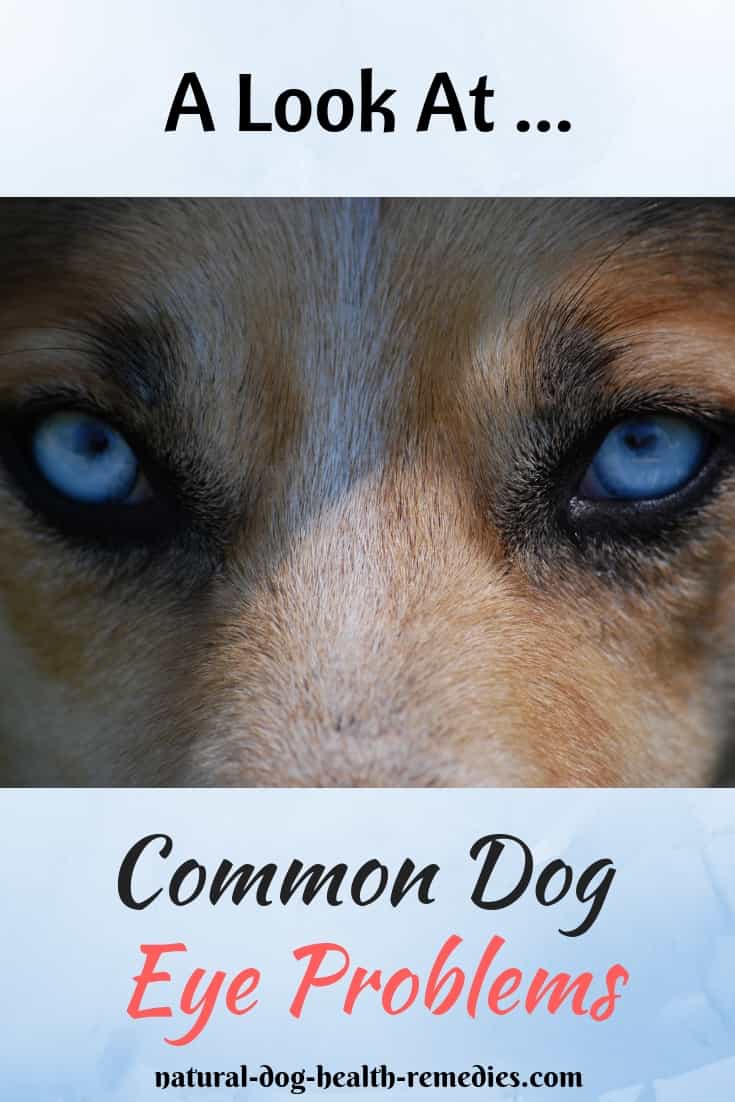 While it is not possible to prevent certain dog eye problems from occuring (e.g. cataracts caused by old age), there are things that dog parents can do to protect their dogs' eyes and prevent eye injuries. For example:
- While traveling in a car, keep your dog inside the car. Do not allow your dog to hang his head out a window of the car while riding. Damage to the eyes can easily occur from debris, insects and the wind. Also the ears and nose can be affected.
- When out for a walk with your dog, make sure he is on a leash to minimize the chance of dog or cat fights.
- While grooming your dog, also check your dog's eyes to see if there is any swelling, redness, clouding, etc. in the eye or area of the eye.
- Watch out for abnormal behavior such as squinting, blinking, pawing, and/or excessive tearing.
- If you have a dog with long hair, trim the hair around the eyes so that the hair does not rub against the eyeball.
- Do not attempt to remove foreign objects (e.g. foxtail, a thorn, etc.) from your dog's eye. Take him to a veterinarian immediately.
- Feed your dog eye-supporting foods to help maintain his eye health.
Eldredge, et al. Dog Owner's Home Veterinary Handbook 4th edition (Wiley Publishing, 2007).
R.H. Pitcairn, The Complete Guide to Natural Health for Dogs and Cats (Rodale, 2005).
D. Hamilton, Homeopathic Care for Cats and Dogs (North Atlantic Books, 1999).
Does Your Dog Have Tear Stains Under The Eyes?