
Dog Back Problems and Back Pain
Overview
Although dogs do a lot less back bending and twisting than we do because they don't walk upright, that doesn't mean they don't suffer from back problems.
Besides the occasional pulled muscle, they also suffer from more serious back problems such as vertebral malformations, vertebral dislocations, bone fractures, and even cancer of the vertebrae.
Perhaps one of the most common causes of dog back problems is intervertebral disc disease (IVDD).
The Dog's Spine
The dog's spine (and ours as well!) is made up of small bones called "vertebrae". In the case of dogs, the vertebrae extend from the base of the skull to the end of the tail.
Located between the vertebrae are cushion-like intervertebral discs. Each disc is made up of two parts: An outer fibrous ring called the annulus fibrosis, and a dense, jelly-like interior called the nucleus pulposus.
These discs provide shock-absorbing cushioning between each vertebra and allow the neck, spine, and tail to bend.
What is Intervertebral Disc Disease?
IVDD is a back condition in which the interior "jelly" becomes calcified and hardened, losing its function as a cushion and shock-absorber.
Pressure or trauma can then cause the calcified jelly to rupture, or herniate, causing a part of the disc to protrude (bulge) upward into the spinal canal, where the spinal cord resides.
This protrusion puts pressure on the spinal cord, resulting in a whole range of problems, such as back pain, lameness, loss of feeling and function of the limb, etc.
Types of IVDD
Two types of intervertebral disc disease can occur:
Hansen Type IThis occurs when the "jelly" material explodes into the spinal canal. This condition is commonly known as "slipped disc".
Hansen Type I is usually an acute condition, and the problem can occur anywhere on the spine.
Long-bodied dogs with short legs (e.g. Basset hounds, dachshunds, beagles, Shih Tze, and Pekingese) are prone to this type of disc disease.
Type I disc disease is seldom caused by trauma such as being hit by a car. It is a genetic predisposition because of the dog's body shape - It is all stretched-out with relatively little support for the spine. As such, herniation in these breeds usually occurs in the middle of the spine.
Hansen Type IIThis occurs when the "jelly" material progressively and gradually protrudes into the spinal canal.
Since the protrusion occurs progressively, the pain is not as acute and severe as Hansen Type I.
Large breed dogs (e.g. Labradors, German Shepherds, and Doberman Pinschers) are more prone to Type II. It is usually caused by a disc weakened by degeneration due to age or physical trauma (e.g. being hit by a car), or the onset of a disease (such as cancer).
Signs of a Dog Having IVDD
As mentioned above, depending on the type, the onset of IVDD can be either acute or chronic.
The effect on the spinal cord will depend on the amount and severity of the pressure. Also, depending on the location of the problematic disc, different area of the dog's body will be affected.
For example, if the problem is located in the neck area, it may affect the entire body. If it is located in the middle of the dog's back, it may affect the rear legs and/or abdominal organs.
When the protruded disc puts pressure on the spinal cord, the dog experiences pain, which can be mild to intense.
If it occurs in the middle of the back, you can see the dog arch his back up due to back pain.
If it occurs in the neck area, the dog will become reluctant to move his head due to neck pain, and may even stop eating and drinking as he does not want to lower his head.
Other signs include:
- walking very slowly, or wobbly;
- limping or having trouble moving;
- shivering from the pain;
- crying and whining when touched.
In severe cases, the dog may:
- be partially or completely paralyzed;
- suffer from urinary and fecal incontinence.
Obesity and Dog Back Problems
Dogs that are overweight are more prone to develop back problems because of the extra pressure on the spine. Another reason to keep your dog's weight in check! This will help relieve or even eliminate some back problems in dogs.

Conventional Treatment
 In mild cases of dog back problems, conventional treatment include medications, crate confinement and rest with minimal physical activity for several weeks. Medications include:
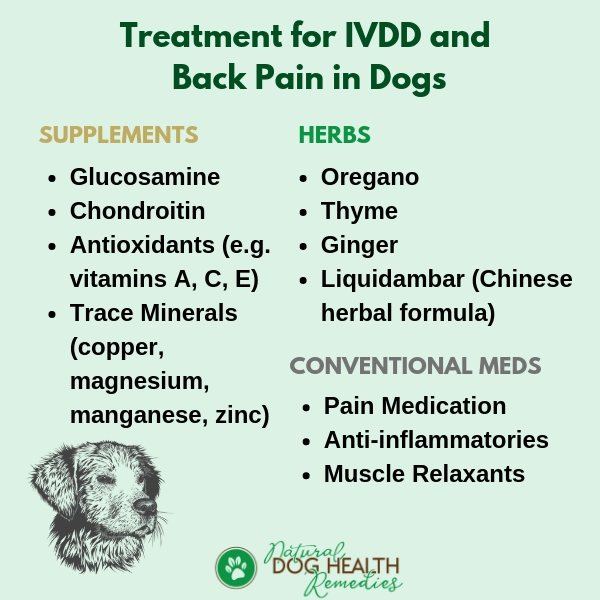
- Pain Medication: to relieve pain caused by the disc problem.
- Muscle Relaxants (e.g. Diazepam, Methocarbamol): to treat muscle spasms brought on by IVDD.
- Anti-inflammatory Medications (e.g. corticosteroids and NSAIDs): to reduce swelling and inflammation.
In more severe cases, e.g. for dogs that are paralyzed or chronically affected by the condition, surgery to either remove the protruding disc material or cut away a portion of the bone that surrounds the spinal cord is sometimes necessary.
Full recovery may or may not be possible depending on the location and severity of the problem.
At Oklahoma State University (and probably other veterinary colleges and/or hospitals), a procedure called laser disc ablation is now available to treat IVDD in dogs.
It involves inserting tiny needles through the skin of the back into the damaged discs. Laser is then used to vaporize and eliminate the protruding discs.
The procedure is less invasive than surgery and can also be used as a preventive measure for dogs prone to back problems.
Manage Your Dog's Back Pain Using Natural Home Remedies
Except in the more severe cases, you can use natural remedies and dietary supplements for pain relief and prevention of dog back problems.
Glucosamine and Chondroitin
A dietary suppplement containing glucosamine and chondroitin is highly recommended to help repair and strengthen the damaged cartilage.
Antioxidants
Antioxidants protect cells from damage caused by free radicals, which are produced when a cell is exposed to toxins. Free radicals are also produced by cells surrounding the joint whenever excess or abnormal strains and pressure are applied.
Vitamins C, A and E are effective antioxidants and are beneficial for dogs with back problems. Other antioxidants include culinary herbs such as oregano, thyme, ginger, and parsley. These dried herbs can be sprinkled on a dog's food - they are good antioxidants and nutritious too.
Other Nutrients
Other nutrients that have shown effects in helping dogs with back problems and arthritis include copper, magnesium, manganese, and zinc.
An Effective Supplement for Dog Back Problems

This supplement contains bovine tracheal cartilage which is a source of Chondroitin found in high concentration in the spine and intervertebral disks. It also contains numerous vitamins and minerals that are beneficial for dogs with back problems.
It helps to lubricate and maintain healthy connective tissue in the spine and disks.
Natural Pain Relief
If your dog is suffering from back pain, and you do not want to give him conventional pain medications which may cause harsh side-effects, consider using natural pain relief such as herbal and homeopathic remedies. For more information, please visit our page on Herbal Pain Remedies.
 References
Eldredge, et al. Dog Owner's Home Veterinary Handbook 4th edition (Wiley Publishing, 2007).
C.J. Puotinen, Natural Remedies for Dogs and Cats (Keats Publishing, 1999).
M.L. Wulff-Tilford and G.L. Tilford, Herbs for Pets (Bowtie Press, 1999).
R.H. Pitcairn, The Complete Guide to Natural Health for Dogs and Cats (Rodale, 2005).